
Go Redmond educates and inspires the community to embrace a culture of walking, biking, ridesharing, and transit in Redmond
Redmond Light Rail Basics
Tag: transit
Riding light rail is an easy, efficient way to get around the region—whether you’re commuting to work, heading into Seattle, or exploring nearby neighborhoods. To get started, purchase an ORCA card, which allows you to tap and ride seamlessly across buses, trains, and other transit services. Be sure to tap your card before boarding and keep proof of payment with you during your trip.
Light rail trains run on a regular schedule, with clear signage and digital displays showing arrival times. Trains run every 8 minutes in Redmond!
If your trip involves transferring from a bus, the process is easy! Many bus routes connect directly to Redmond light rail stations, and using an ORCA card ensures your fare transfers automatically within a two-hour window, no need to pay twice. Pay attention to posted schedules or use transit apps to time your connections smoothly.
If you plan to drive to the light rail, park & ride facilities are available at the Marymoor Station and the Redmond Technology Station. These lots can fill up quickly during peak hours, so arriving early or considering alternative transportation (like biking, walking, Lime scooters, or Redlink) can help.
Trip planning is simple with tools like the Sound Transit Trip Planner or Google Maps. Enter your starting point and destination to get step-by-step directions, including walking routes, transfers, and travel times.
With a little preparation, riding light rail in Redmond can be a fast, reliable, and stress-free way to travel.
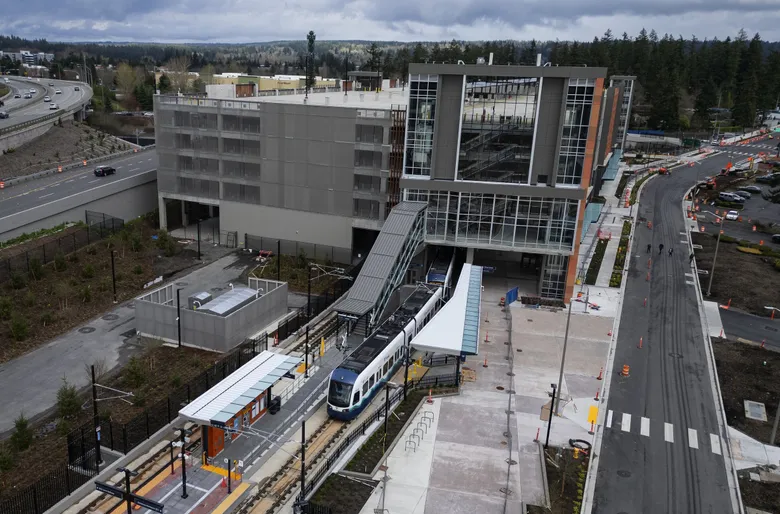
Whether you’re going to a World Cup game in Seattle or headed to a meeting in Bellevue, you may be wondering where to park to take Link Light Rail. With Redmond’s four new light rail stations in Downtown, Marymoor, and Overlake there are options to park to catch the train.
Park and Rides have parking available on a first come, first served basis. Park and Rides near the Light Rail stations include these, please note that the Downtown Station and Overlake Village Station have parking within a 1/2 mile of the station, but not at the station like Marymoor Village and Overlake Technology Station.
NOTE: The 83rd street Transit Center is a 10 minute walk (.5 mile) to the Downtown Redmond Station. Lime Scooters/Bikes or the RedLink Shuttle can also help make the connection to the station.
377 parking spaces
Limited, on-street parking is available around the station. On-street spaces have a 2-hour time limit, Monday thru Saturday 9am to 9pm
Paid, hourly parking in private garages may be available around the station, individual rates and rules apply
No light rail parking is allowed at the Redmond Town Center. Parking is strictly enforced.
Parking at the Marymoor Village Light Rail Station
NOTE: This Park & Ride is a 9 minute walk (.4 miles) from the Village at Overlake Station
203 parking spaces
Covered bike racks
Limited, on-street parking is available around the station. On-street spaces have a 2-hour time limit, Monday thru Saturday 9am to 9pm
With light rail now serving Redmond, there are new, convenient ways to get around the city and across the region.
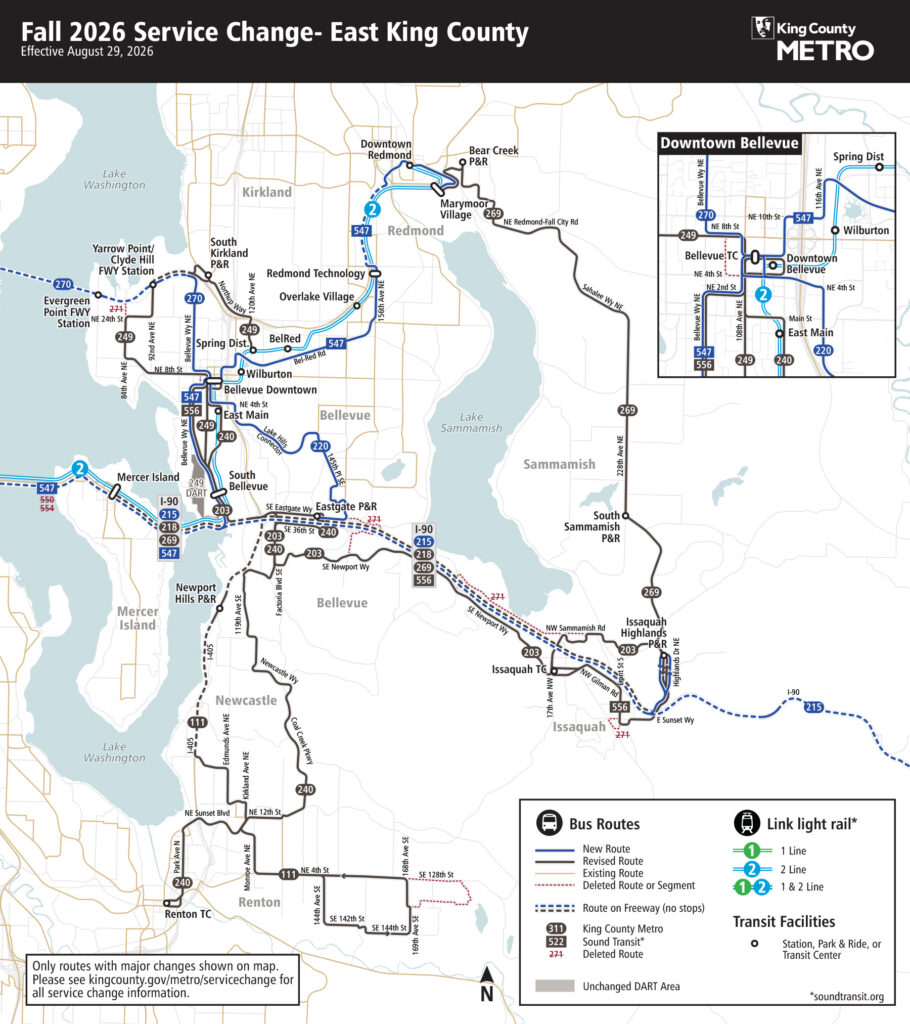
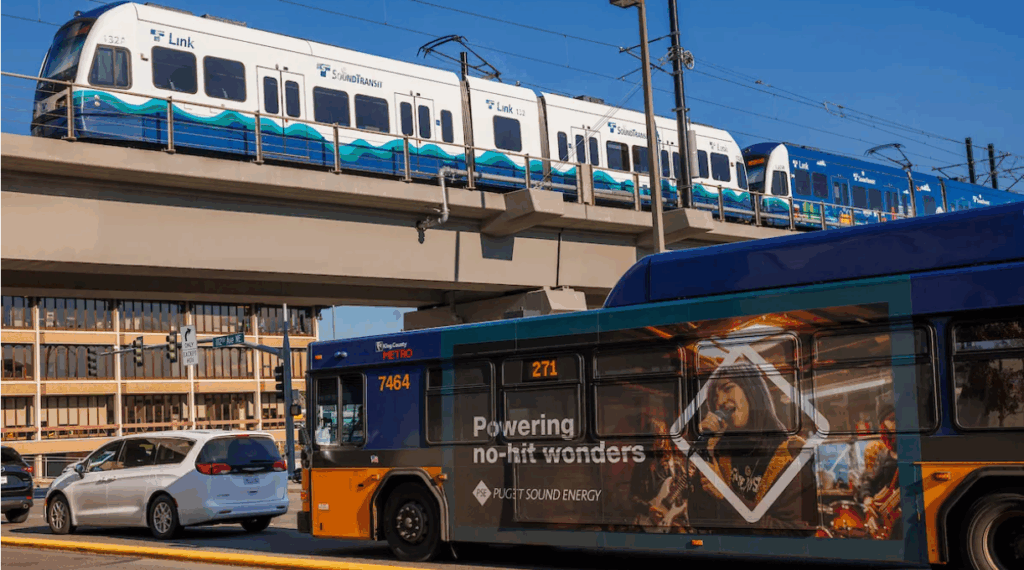
King County Metro buses provide reliable connections from Redmond neighborhoods to one of the city’s four light rail stations in Downtown, Overlake, and Marymoor Village.
Below is a neighborhood-by-neighborhood look at the local bus routes that make it easy to connect to light rail, no car required.
Education Hill
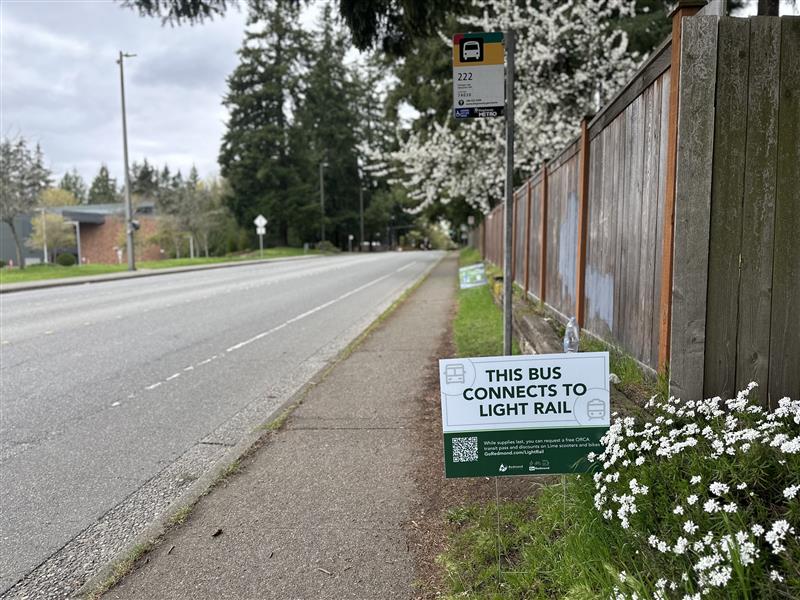
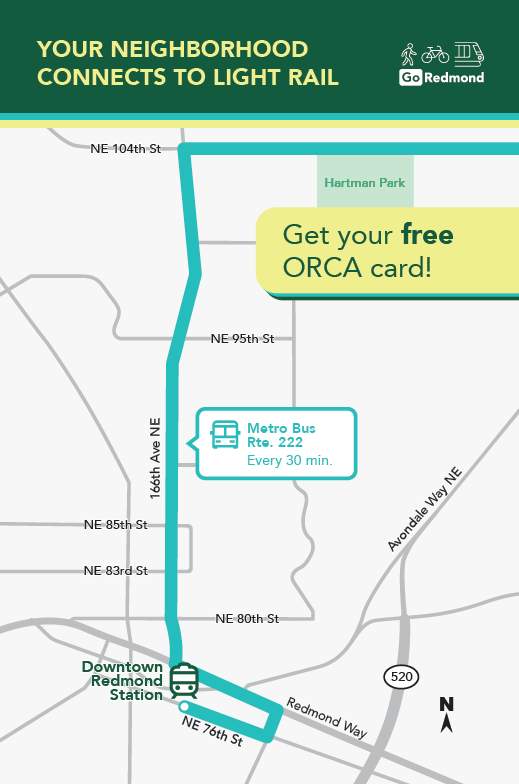
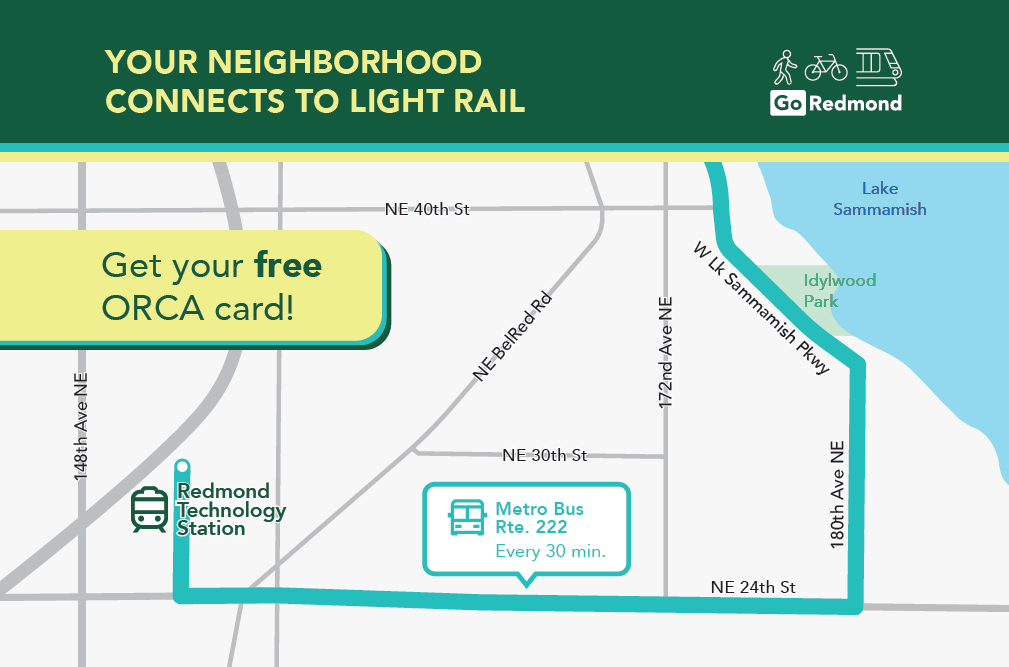
Route 222 Frequency: Regular all-day service (new in 2025) Serves: Downtown Redmond Station; Redmond Technology Station Notes: A new route designed specifically to connect Education Hill directly to light rail.
Route 250 Frequency: About every 30 minutes on weekdays; hourly at other times Serves: Downtown Redmond Station Notes: Serves northeast Education Hill and provides a reliable option outside peak hours.
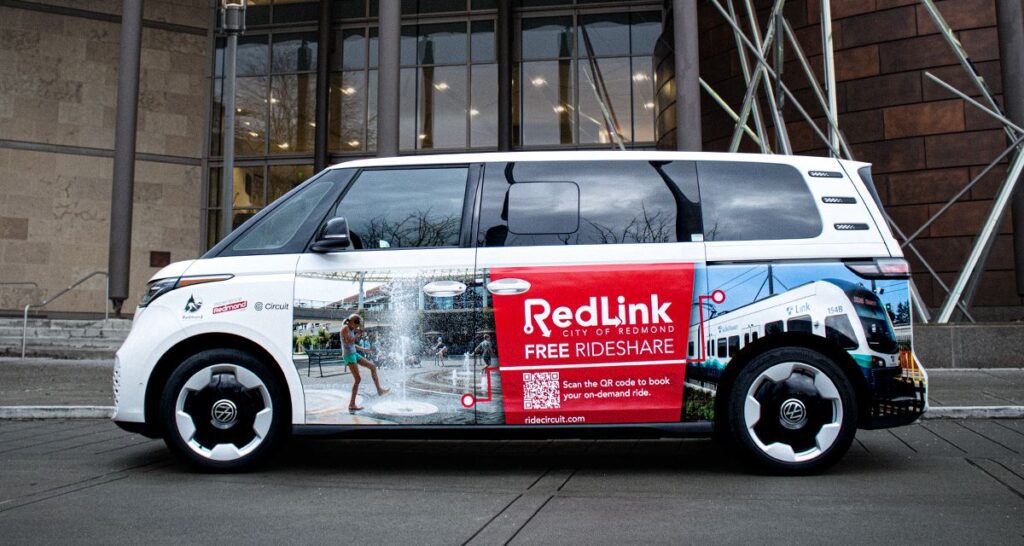
RedLink Frequency: On-demand rides via the Circuit App. Notes: Pick up in the service area (for Education Hill the boundary is near Redmond Middle School and goes south down 166th towards Downtown)
Idylwood
Route 222 Frequency: Regular all-day service Serves: Downtown Redmond Station; Redmond Technology Station Notes: Direct neighborhood access to light rail via Downtown Redmond.
RapidRide B Line Frequency: About every 30 minutes on weekdays; hourly at other times Serves: Downtown Redmond Station Notes: Frequent service along major corridors serving parts of Idylwood.
Grass Lawn
RapidRide B Line Frequency: Frequent weekday service; reduced frequency evenings and weekends Serves: Downtown Redmond Station Notes: High-capacity service along NE 8th St / 148th Ave NE corridor.
Route 245 Frequency: Regular local service (varies by time of day) Serves: Downtown Redmond Station (via transfer or direct routing depending on trip) Notes: Provides neighborhood coverage and connections to other frequent routes.
Route 225 Frequency: Every ~10 minutes during weekday peak; ~15 minutes off-peak; ~30 minutes early morning and late night Serves: Downtown Redmond Station Notes: Serves the northern portion of Grass Lawn with very frequent peak service.
Willows Road / Rose Hill
Route 225 Frequency: Frequent weekday service; reduced frequency evenings and weekends Serves: Downtown Redmond Station Notes: One of the primary routes connecting this area to light rail.
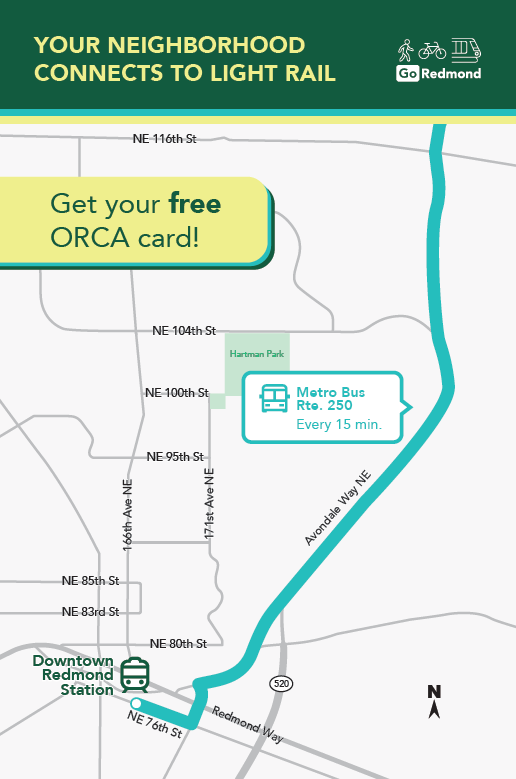
Route 250 Frequency: About every 15 minutes on weekdays; about every 30 minutes nights and weekends Serves: Downtown Redmond Station Notes: Updated in the 2025 network to directly connect to light rail.
DART 930 Frequency: Evening-focused service (weekdays until ~10 p.m.; weekends until ~7 p.m.) Serves: Downtown Redmond Station Notes: Demand-responsive service for lower-demand and off-peak travel times.
Southeast Redmond
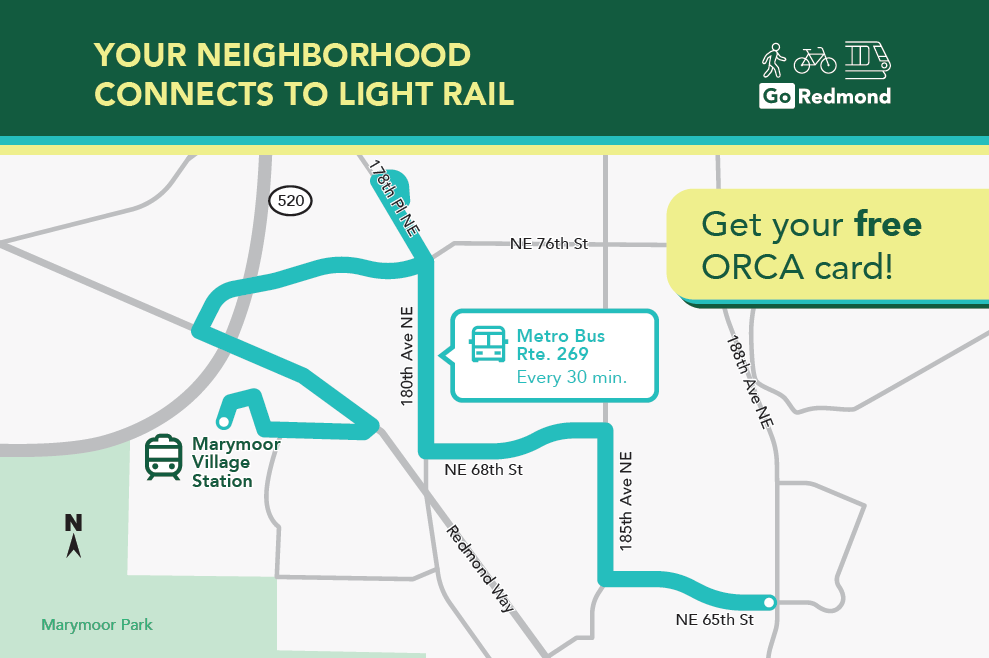
Route 269 Frequency: About every 15 minutes on weekdays Serves: Marymoor Village Station Notes: Primary connection from Southeast Redmond to light rail.
Avondale Road Area
Route 250 Frequency: About every 15 minutes on weekdays; about every 30 minutes nights and weekends Serves: Downtown Redmond Station Notes: Serves portions of the Bear Creek and Avondale–Redmond corridor.
Route 269 Frequency: About every 15 minutes on weekdays Serves: Marymoor Village Station Notes: An option for Avondale-area residents closer to Southeast Redmond.
Plan Your Trip and Give It a Try
With frequent service, new and improved routes serving the station, and easy transfers to light rail, taking transit from Redmond neighborhoods is a practical and stress-free way to get around.
You may find it’s easier (and more relaxing) than you expected.
The City of Redmond has partnered with Circuit to drive community connection through local microtransit! An on-demand, free, all-electric ride service is available to help residents and visitors get around Downtown Redmond, Southeast Redmond, and Education Hill easily, affordably, and sustainably. Whether you’re heading to local businesses, catching light rail, or running errands, this service makes local trips simple with no car required. This pilot program is expected to run through June 2027, thanks to funding from the City of Redmond, Lodging Tax Advisory Committee, and the Washington State Regional Mobility Grant.
Rides are completely free! Riders must be older than 16 to ride. Download the Circuit app to request a ride!
Transit, including light rail, is free for riders 18 and younger thanks to Move Ahead Washington, a statewide transportation funding package. All youth ages 6-18 qualify for a free Youth ORCA card that can be used for rides on all participating transit agencies, including Metro and Sound Transit.
Youth ORCA cards can be requested online and mailed to your home address (proof of age, such as a student ID card, required) or at an ORCA neighborhood pop-up location. Youth without an ORCA card can present their Student ID to the driver as they board and to any transit official upon request. Using a Youth ORCA card allows transit agencies to better understand how many young people are riding transit, including where and when.
Parents, are your teens ready to ride transit on their own? Remind them of these general rules before they head out:
Be aware of your surroundings
Be courteous and respectful of other riders
Use headphones and keep music and videos at a low volume
Share your location with a parent/guardian
For teens ready to ride transit independently, it’s as easy as 1, 2, 3!
Plan your trip: Plan your trip to find the best route(s) and track your upcoming bus or light rail arrival. Use Metro’s trip planning tools (or Google Maps) to find the best route and schedule for your day. Arrive at your stop a few minutes early. Always have a plan for how you will return home, too.
Tap your Youth ORCA card: Tap your ORCA card on the card reader inside when boarding the bus, or on the dock or platform before boarding light rail. If you don’t have an ORCA card, youth can always just get on board.
Be ready for your stop: On buses, pull the yellow cord or press a red stop button when approaching your stop to alert the driver. Exit through the bus’s back doors, if possible. Light rail trains stop at all scheduled stops, so be ready to get off when your stop is next.
Overlake School Students in 7th and 8th grades wrote a blog for teens riding the 2 Line. Check out their notes and recommendations for things to do here.
King County Metro and Sound Transit have been preparing for light rail by adjusting bus routes to better serve these stations. Below is a list of stations in Redmond and information on which buses serve each of these locations.
203 parking spaces are available at the Overlake Village Park & Ride (2560 152nd Ave NE, Redmond, WA 98052) which is a 6 minute/.3 mile walk from the light rail station.
Redmond has more ways to get around than ever before—and not all of them involve driving alone. All these options can be confusing for the unfamiliar, so Go Redmond is here to help break it down.
Whether you’re commuting to work, heading to light rail, or running errands around town, there’s likely a transportation option that fits your trip, schedule, and budget. Here’s a quick guide to help you choose what works best.
Metro Flex: On-demand, flexible transit when fixed bus routes don't work well
Metro Flex is an on-demand, shared ride service like a public Uber that operates within a defined zone. You request a ride via app or phone, walk to a nearby pickup point, and share the ride with others.
In Redmond, this is currently only available in the Overlake neighborhood.
Costs the same as a bus fare (typically $3 adult)
If you use your ORCA card, you can transfer for free to or from a bus or light rail.
Open to the general public in service zones
Designed for short local trips and first/last mile connections to transit
MetroFlex’s Redmond service area is in the Overlake neighborhood
Community Van: Community-organized group trips where transit doesn’t exist
Community Van is a pre-scheduled, group-based service coordinated by a local partner (in Redmond, that is Hopelink). Community Van provides six-passenger and 12-passenger vans for prescheduled trips. Destinations can be anywhere within a two-hour drive of Redmond and can occur any day of the week 24 hours a day.
Costs the same as a Metro bus fare ($3; youth free)
Open to anyone, but requires:
At least 2 riders
Advance booking (≥2 days)
Trips are driven by volunteer drivers who must first complete a short training
Lime and Bird electric bikes and scooters are ridden past Metro buses on May 1, 2025 for Bike Everywhere Month in Seattle, Wa.
Bike or scoot your way to light rail and earn rewards along the way! Rent a Lime bike or scooter, ride to a transit hub, park in designated spots and earn rewards from King County Metro.
You can earn free scooter rentals and transit trips when you take a Lime scooter or bike to get to a light rail station in Redmond.
STEP 1 – Download and link accounts
Download the Lime and Transit GO Ticket apps and create accounts. Then connect all accounts.
STEP 2 – Earn points
Bike or scoot to transit. Remember, your trip must last at least 15 minutes or a minimum of a quarter mile. Park at the preferred parking spots, as shown in the app, and end your trip on the app.
STEP 3 – Redeem your points
You will receive a Lime notification. Next, open up the Transit GO Ticket app and check your rewards balance. You should have received 300 points for parking correctly. Redeem your points for a free-transit trip worth $3. Must be used within 24-hours.
Activate your transit ticket (for a King County Metro bus, Sound Transit bus or Link light rail) within 24 hours. You will receive 700 points which can then be redeemed for $7 off a future bike or scooter rental. To redeem these points, input the code into your Lime app.
Area Transit Providers to Accept Credit and Debit Cards, Digital Wallets as Fare Payment
On February 23, ORCA is launching a new Tap to Pay feature allowing riders to use credit and debit cards, and digital wallets, to pay for transit across the Puget Sound region.
Riders can simply tap their contactless Visa, Mastercard, Discover® Network, or American Express credit or debit cards, or cards in digital wallets, using Apple Pay™, Google Pay™, or Samsung Pay™ to ride. This new feature expands access to public transportation and supports seamless travel experiences for both daily riders and visitors alike.
This new feature also comes as Seattle and the Puget Sound region prepare to host several large events in 2026. With many international visitors expected to travel across the region, Tap to Pay simplifies transit and aligns with global expectations for convenient payment options.
“The addition of Tap to Pay is a major milestone for transit in King County,” said King County Executive Girmay Zahilay. “It brings our system into the modern era and makes everyday trips more convenient for riders while opening the door for more people to choose transit. As we prepare to welcome the world to our region this summer, visitors will be able to explore King County with the same seamless experience.”
“Making transit an easier choice is fundamental to everything we do at Sound Transit,” said Sound Transit Chief Executive Officer Dow Constantine. “Adding Tap to Pay as a fare option increases rider convenience and helps occasional riders get on board.”
“Adding Tap to Pay is a major step forward in how our region moves people and delivers on our commitment to making Puget Sound a modern, transit-friendly destination,” said Christina O’Claire, ORCA Joint Board Chair and King County Metro Mobility Division Director. “By giving visitors the ability to tap and ride using the cards they already carry, ORCA is removing barriers and creating a welcoming and inclusive transit experience. This launch ensures our regional transit system is easy to use and benefits both residents and the global community we’re preparing to host.”
How the new Tap to Pay feature works:
Riders can pay for transit with most contactless-enabled credit or debit cards with a contactless symbol, , or with digital credit or debit cards via Apple Pay, Google Pay, or Samsung Pay, by tapping their cards or smart devices on ORCA card readers.
ORCA cards will still be issued and accepted across the region on buses, trains, and ferries. ORCA cards continue to provide the most cost-effective, convenient benefits for many riders across the region, especially those enrolled in free or reduced fare programs such as ORCA LIFT, Senior RRFP, Disabled RRFP, Youth, and those with employer or organization sponsored ORCA cards.
Contactless payments through ORCA are not accepted on:
Seattle Monorail
Washington State Ferries
King County Metro DART, Community Vans, Metro Flex
Community Transit DART, Zip Shuttle
Pierce Transit SHUTTLE, Pierce Transit Runner
Everett Transit Paratransit
Some of these services may offer other ways to pay using contactless payments outside of the ORCA system. Tap to Pay will soon be available on Kitsap Transit Fast Ferries, Foot Ferries, and King County Water Taxi.
Riders paying with contactless credit or debit cards are charged an adult fare and will still receive the ORCA 2-hour transfer window benefit, allowing for seamless transfers across Puget Sound, as they do today.
Riders cannot receive discounts (Senior, Youth, ORCA LIFT, Disabled) or passes. Riders with ORCA cards that receive discounts are encouraged to keep tapping their existing ORCA cards.
Customers will not be able to pay for multiple riders or groups using one card or device. Every rider will need their own payment method.
Cards need to be tapped directly on the ORCA card readers. Riders should remove physical cards from their wallets before tapping to avoid unwanted charges on other cards or tap failures.
If you have both an ORCA card and a credit or debit card in Google Wallet™, the card reader should default to charging your digital ORCA card when tapped. If you wish to use a digital credit or debit card, select that form of payment on your smart device before tapping.
For Apple Pay users with Express Mode enabled, riders can simply hold their iPhone or Apple Watch near a card reader to ride transit across the Puget Sound Region — without having to unlock or wake up their device. And with power reserve, if their iPhone needs to be charged, they can still use it to ride transit.
Riders who tap with a contactless payment method may be subject to fare inspection on some services. Fare inspectors will not scan credit or debit cards; however, they will ask Tap to Pay riders to share the last 4 digits of their card number to confirm fare was paid. This allows fare inspectors to input the last 4 digits of the card used to confirm that the fare transaction occurred. More information on how fare inspection will work can be found here: https://info.myorca.com/contactless/#fareinspectionGo to https://info.myorca.com/contactless/#fareinspection
ORCA cards remain the best option for many, but this enhancement to the ORCA Product suite makes riding transit easier than ever for all types of riders.
Image courtesy of Sound Transit.
“The completion of the 2 Line exponentially expands employment, housing and recreation opportunities for people on the east and west sides of Lake Washington,” King County Executive and Sound Transit Boadmember Girmay Zahilay. “When the 2 Line opens, it will serve 26 stations and more than 35 miles, while knitting together first King County cities and two Snohomish County cities, creating new transit hubs throughout the region.”
Sound Transit announced that the Crosslake connection will open for riders on March 28th. This is the final segment of the 2 Line which will cross Lake Washington and connect with the 1 Line at International District/Chinatown Station, creating a fully integrated regional light rail system. This new addition to the East Link included two new stations, Mercer Island and Judkins Park.
The 2 Line will operate between Lynnwood and Redmond in addition to the 1 Line between Federal Way and Lynnwood. Service will run on the 1 and 2 Lines from 5 a.m. to 1 a.m. Monday-Saturday and from 6 a.m-midnight on Sundays. Trains will run every 8 minutes during peak times at the new stations and between 10-15 minutes the rest of the day. Combined 1 Line and 2 Line headways between Lynnwood and International District/Chinatown will be every 4 minutes, providing addtional capacity through the busy core of the system.
To keep up with opening day events and details visit https://www.soundtransit.org/crosslake This link will be updated as plans continue to be finalized. Check back often to stay up to date.